THE HUMAN DIGESTIVE

Why do you eat three meals a day? What happens to the food that you eat? As everyone knows, food is essential to our life. Food is what keeps our body alive. A person should eat different kinds of food to provide the body with the necessary nutrients to all its activities.
Food however, must first undergo changes within your body. This process includes breaking down of food to a simpler substances so that they can be absorbed by the blood and be distributed to the different parts of the body. This is called digestion.
How do you break foods into tiny pieces? What organs help in the digestive process? Let’s find out by studying the digestive system.
PARTS OF THE HUMAN DIGESTIVE SYSTEM
The human digestive system is made up of organs that work together. Its main function is to change the food you eat into forms that your body cells can use.

The human digestive system is composed of the mouth, esophagus, stomach, small intestine, large intestine, rectum, and anus.
There are also other body parts that helps in digestion. These include our teeth, tongue, salivary glands, liver, gall bladder, pancreas, gastric glands of the stomach, and intestinal glands of the small intestines.
The human digestive system breaks down the food into simpler forms that the body cells can use them.
The human digestive system is made up of the mouth, esophagus, stomach, small intestine, large intestine, rectum and anus.
The human digestive system is made up of the mouth, esophagus, stomach, small intestine, large intestine, rectum and anus.
DIGESTION IN THE MOUTH
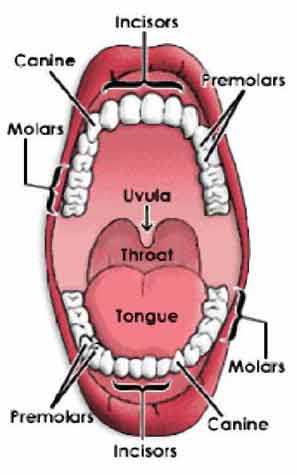
Digestion starts in the mouth. The teeth helps break the food apart. The different kinds of teeth have different functions.
The incisors are the sharp cutting teeth. The canines are the pointed teeth use for tearing food.
The premolars are double-pointed teeth for crushing foods. The molars have rounded surface for grinding the foods.
The tongue moves the food around and mixes it with the saliva. The saliva is produced by three pairs of salivary glands. It contains water and mucus.
As the food is chewed, the saliva wets it and makes the food easier to swallow. The saliva contains an enzyme known as ptyalin, which changes the starch of rice, bread, and other starchy food into simple sugar. Only starch can be digested in the mouth.
ESOPHAGUS

When the food is swallowed, it moves down into the esophagus. The esophagus is a muscular tube leading to the stomach. It is about 22 cm long and 2.5 cm in diameter.
The movement of the muscles of the esophagus pushes the food down to the opening of our stomach. This muscular movement of the esophagus is called peristalsis.
The esophagus is a muscular tube which connects the throat to the stomach. Peristalsis is the muscular movement of the esophagus.

DIGESTION IN THE STOMACH
The stomach is located in the abdomen below the lower ribs at the left side of our body. The stomach is small when empty, but it can hold two liters of food when full. It is elastic.
The stomach is like a bag with many small glands along its walls. These glands produce gastric juice which mixes with the food and breaks it down into smaller particles.
Gastric juice has enzyme called pepsin that breaks down proteins. It has also hydrochloric acid which dissolves minerals kills bacteria that enter with the food.
The stomach squeezes food back and forth to make the juice act on all the food , until the food is partly in thick liquid form called chyme.
The stomach is a bag-like organ that continues the digestion of food because it contains hydrochloric acid. The enzyme pepsin helps digest proteins.
SMALL INTESTINE

From the stomach, chyme goes to the small intestine. The small intestine is the main organ of digestion, because it is where most of the digestive processes take place.
The liver and the pancreas helps the small intestine in the digestion of food. The liver produces bile which is stored in the gall bladder. Bile breaks up fats. The pancreas produce pancreatic juice that acts upon carbohydrates, proteins, and fats.


All together, with the actions of the bile, pancreatic juice and intestinal juice, the food is completely digested. Complete digestion takes place in the small intestine. Along the inner walls of the small intestines are very tiny projections called villi.
The villi absorb the digested food. The digested food reaches the blood stream.
The blood carries the digested food to the different cells of our body.
DID YOU KNOW?
Do you know that the small intestine is the longest internal organ of the body? The small intestine has an average length of 4.5 to 6 meters. The small intestine is divided into three parts, the duodenum, the jejunum, and the ileum. The length of the small intestine is also 5 times your height!
LARGE INTESTINE
Not all the foods we eat can be digested. Undigested foods such as fibers of fruits and vegetables and hard seeds move on to the large intestine. The large intestine removes the liquid from the undigested food leaving a solid mass of waste.

The solid mass is called feces. Feces is pushed out of the large intestine into the rectum. Waste stays in the rectum until it passes out of the body by defecation through the anus. The anus is the opening of the rectum.

Science ideas:
· Digestion is the process of breaking food into smaller pieces and changing these into soluble materials which are absorbed by the blood and distributed to the different cells of the body.
· The digestive system is made up of organs such as the mouth, esophagus, stomach, small intestine and large intestine, rectum and anus.
· Digestion of food starts in the mouth and is finished in the small intestines.
· Digestive enzymes helps digest starch, protein, and fats until they are absorbed into the bloodstream.
· Peristalsis is the contraction and relaxation of the muscles of the esophagus, stomach, and small intestine that squeezes and pushes the food.
The Process of Digestion ( Video )
Source/Reference:
Science Health and Environment
( Towards an Active and Responsible Living )
by Rosalinda L. Tabugo
Editors:
Felipe O. Saclamitao
Teresita T. Batad
Antonio Carlos M. Maralit


No comments:
Post a Comment